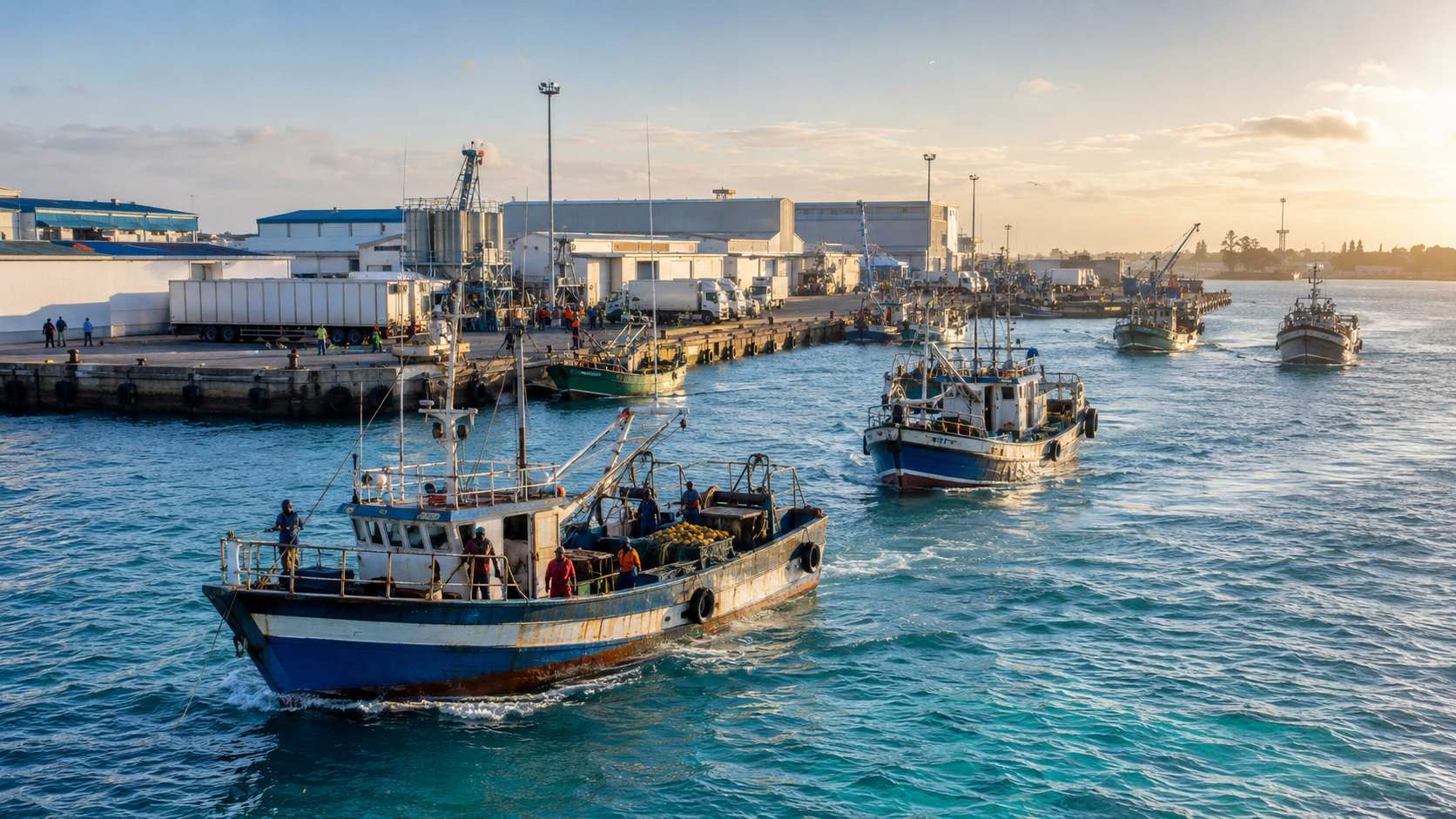
Kenya’s Blue Economy is an emerging investment frontier in East Africa. Featuring a 600-kilometer Indian Ocean coastline, a 200-nautical-mile Exclusive Economic Zone (EEZ), and inland freshwater bodies, the sector presents diverse opportunities across the marine value chain:
1) Commercial Harvesting & Aquaculture: Deep-sea commercial fishing in the EEZ, coastal mariculture (seaweed, oysters, prawns, crabs), and inland freshwater aquaculture (tilapia, catfish) to meet rising domestic and international demand.
2) Value Addition & Fish Processing: Investment in cold-chain infrastructure (refrigerated transport, cold storage) and processing plants (filleting, packaging, canning) to reduce post-harvest losses and expand export earnings.
3) Maritime Support & Marine Innovation: Vessel chartering, ship repair, marine fuel supply, equipment provisioning, and offshore logistics. Marine biotechnology also offers growth in producing biofuels, pharmaceuticals, cosmetics, and nutraceuticals from algae and seaweed.
4) Logistics & Trade Connectivity: Anchored by the Port of Mombasa and Lamu Port (LAPSSET Corridor), Kenya serves as a regional trade gateway to landlocked neighbors (Uganda, Rwanda, South Sudan, DRC, Ethiopia). This is reinforced by its membership in the EAC, COMESA, and AfCFTA.
Under Kenya Vision 2030, sustainable fisheries are designated as a strategic pillar for economic transformation, job creation, food security, and regional trade in the Western Indian Ocean.
This article examines the legal and regulatory framework governing investment in Kenya’s fisheries sector, offering a practical roadmap of key statutory requirements, principal regulatory authorities, and the step-by-step sequence for securing licenses and approvals.
The Legal and Regulatory Framework
Establishing a successful fisheries enterprise in Kenya requires compliance with a sophisticated legal and regulatory framework that extends well beyond fisheries licensing. Investors must navigate requirements relating to corporate structuring, fisheries management, maritime safety, environmental protection, labour and immigration, taxation, customs administration, and sector-specific operational approvals. These obligations are administered by multiple national and county government agencies, each exercising distinct statutory mandates.
Accordingly, a well-planned and carefully sequenced regulatory strategy is critical. Obtaining the necessary approvals in the correct order not only facilitates regulatory compliance and minimizes operational delays but also provides the legal foundation necessary for the long-term viability and commercial success of the enterprise.
The legislative framework is principally anchored in the Fisheries Management and Development Act, No. 35 of 2016, which establishes the legal regime for the sustainable management, conservation, development, and utilization of Kenya's fisheries resources. The Act operates alongside several complementary statutes, including the Merchant Shipping Act, 2009, which regulates vessel registration, maritime safety, and shipping operations; the Environmental Management and Co-ordination Act (EMCA), 1999, which governs environmental impact assessment and environmental compliance; the Companies Act, 2015, which provides the legal framework for the incorporation and governance of business entities; the Investment Promotion Act (Cap. 485), which facilitates qualifying investments; and the County Governments Act together with the respective County Finance Acts, which regulate county licensing, trade permits, and local levies applicable to fisheries enterprises.
The regulatory framework was significantly modernized in 2024 through the promulgation of three key sets of subsidiary legislation under the Fisheries Management and Development Act. The Fisheries Management and Development (General) Regulations, 2024 (Legal Notice No. 124 of 2024) establish the licensing regime for commercial fishing operations, regulate the authorization of foreign fishing vessels operating within Kenya's Exclusive Economic Zone, and introduce mandatory Vessel Monitoring Systems (VMS) for specified vessels. The Fisheries Management and Development (Inland Fisheries) Regulations, 2024 (Legal Notice No. 122 of 2024) govern fisheries activities within Kenya's inland water bodies, including Lake Victoria, Lake Turkana, Lake Naivasha, and the Tana River system. Meanwhile, the Fisheries Management and Development (Recreational Fisheries) Regulations, 2024 (Legal Notice No. 127 of 2024) regulate recreational and sport fishing activities, including deep-sea fishing charters, angling competitions, and trout fishing.
Collectively, these 2024 Regulations have replaced the fragmented and outdated subsidiary legislation that had remained in force under the repealed Fisheries Act (Cap. 378). They now constitute the primary regulatory framework governing new fisheries licence applications and commercial fisheries operations in Kenya. Consequently, investors and practitioners should exercise caution when relying on older commentaries or precedents that continue to reference the superseded regulatory regime.
The institutions governing the industry
Because maritime ventures touch several regulatory spheres, licensing requires coordinated action across a matrix of state bodies rather than a single regulator. The table below sets out who does what.
| Regulatory Body | Key Responsibility & Licensing Mandate |
| Kenya Fisheries Service (KeFS) | Primary regulator for resource management, licensing, quota allocation and enforcement under the Fisheries Management and Development Act, 2016. |
| Beach Management Units (BMUs) | Community-level co-management bodies; BMU concurrence is mandatory for coastal and artisanal operations before a fishing licence is issued. |
| County Governments | Issue licences under the County Finance Acts, including the Aquarium Fisherman's Licence, fish movement permits, fish traders' licences and single business permits. |
|
National Environment Management Authority (NEMA) |
Issues Environmental Impact Assessment (EIA) licences for processing plants, aquaculture facilities and shoreline infrastructure under the Environmental Management and Co-ordination Act. |
| Kenya Maritime Authority (KMA) | Oversees vessel registration, seaworthiness, crew certification and maritime safety under the Merchant Shipping Act, 2009. |
| Kenya Wildlife Service (KWS) | Co-regulates activities within Marine Protected Areas (MPAs) and national marine parks, including tourism and sport-fishing operations. |
|
Kenya Fishing Industries Corporation(KFIC) |
Manages public fishing ports, jetties and commercial cold-storage facilities. |
|
State Department for Blue Economy & Fisheries |
Sets national policy direction under Kenya Vision 2030 and coordinates cross-agency Blue Economy strategy. |
| Sets national policy direction under Kenya Vision 2030 and coordinates cross-agency Blue Economy strategy. | Handle expatriate work permits, tax registration, port access and trade facilitation. |
| KenTrade | Runs Kenya's TradeNet single-window system, verifying trading partners and integrating with KRA and M-Pesa for digital payment of taxes and fees. |
The involvement of multiple regulators means that no single institution can independently complete an investor's licensing and compliance process. For example, establishing a fish processing facility will typically require coordination between KeFS, NEMA, and the relevant County Government, while a commercial capture-fishing venture involving vessels may additionally require vessel approvals from the Kenya Maritime Authority and, where applicable, engagement with Beach Management Units.
Consequently, the sequencing of regulatory approvals is a critical aspect of successful market entry. Failure to obtain approvals in the appropriate order can result in unnecessary delays, increased compliance costs, and operational disruptions. For first-time investors, understanding the institutional landscape and developing a coordinated licensing strategy from the outset is therefore essential to ensuring a smooth transition from investment planning to commercial operations.
Types of fisheries licences in kenya and who can hold them
Kenyan fisheries law does not adopt a one-size-fits-all approach to licensing. Different categories of fisheries licences are subject to different eligibility requirements, ownership restrictions, and operational conditions depending on the nature of the activity being undertaken. While some licences may be available to entities with foreign ownership or participation, others are reserved, either wholly or partially, for Kenyan citizens, locally incorporated companies, or Kenyan-controlled entities.
For foreign investors, understanding these distinctions at the outset is critical. The choice of investment structure, whether through a locally incorporated company, a joint venture arrangement, or another approved vehicle, may determine the investor's eligibility for specific licenses and the extent of participation permitted under Kenyan law. Failure to properly assess these requirements during the planning stage may result in delays, restructuring costs, or inability to obtain the necessary operational approvals.
The table below summarizes the principal categories of fisheries licenses in Kenya, their general purpose, and the entities eligible to hold them:
| Licence | Issuing Authority | Foreign Investor Access | Governing Instrument |
|
General Fisher's Licence |
KeFS / BMU | Restricted to Kenyan citizens | Fisheries Management and Development Act, 2016; L.N. 124/2024 |
|
Aquarium Fisherman's Licence |
County Government | Restricted to Kenyans; foreign JV partner only, not direct holder | County Finance Acts; KeFS clearance |
|
Local Fishing Vessel Licence (capture fishing) |
KeFS / KMA | Kenyan-controlled JV or charter required | Fisheries Act, 2016; L.N. 124/2024; Merchant Shipping Act |
|
Foreign Craft (Distant-Water) EEZ Licence |
KeFS, via bilateral/access agreement | Kenyan-controlled JV or approved access agreement; VMS mandatory | L.N. 124/2024; Fisheries (Foreign Fishing Craft) framework |
|
Support Vessel Licence |
KMA / KeFS | Kenyan-controlled JV generally required | Merchant Shipping Act; L.N. 124/2024 |
|
Sport/Tourist Fishing Permit |
KeFS / KWS | Open to full foreign ownership | L.N. 127/2024 |
|
Trout (Highland Angling) Licence |
KeFS | Open to foreign participation as operator/charter | L.N. 127/2024 |
|
Fish Processing Licence |
KeFS, with NEMA EIA clearance | Open to full foreign ownership | Fisheries Act, 2016; EMCA, 1999; L.N. 124/2024 |
|
Aquaculture Licence / Permit |
KeFS, with NEMA EIA clearance | Open to full foreign ownership | Fisheries Act, 2016; L.N. 122/2024 |
|
Dealer / Fish Trader's Licence |
County Government / KeFS | Open to full foreign ownership | County Finance Acts; L.N. 124/2024 |
|
Export Permit & Fish Health Certificate |
KeFS, KEPHIS coordination | Open to full foreign ownership | Fisheries Act, 2016; Public Health standards |
| Fish Movement Permit | KeFS | Open to any licensed operator, local or foreign-owned | Fisheries Act, 2016 |
Investment structuring considerations for foreign investors
Foreign investors must carefully consider the appropriate legal structure before entering Kenya’s fisheries sector. While Kenya welcomes foreign investment, certain activities may be subject to local participation requirements, access restrictions, or specific licensing conditions.
The appropriate structure whether through a wholly owned entity, joint venture, charter arrangement, or other approved model will depend on the nature of the proposed activity, applicable licensing requirements, vessel ownership arrangements, and regulatory obligations. Early structuring advice is critical to ensuring that the investment model aligns with Kenya’s fisheries framework and avoids costly restructuring at a later stage.
The fisheries licensing roadmap
Entry into Kenya’s fisheries sector requires a coordinated approach to regulatory approvals. Investors must first establish the appropriate investment structure, followed by obtaining the relevant fisheries licenses and sector approvals from the Kenya Fisheries Service.
Depending on the nature of the investment, additional approvals may be required from institutions such as NEMA, the Kenya Maritime Authority, county governments, and other relevant agencies.
Proper sequencing of approvals is essential to minimize delays and ensure smooth commencement of operations.
Key compliance considerations
A fisheries Licence does not grant unrestricted access to marine resources. Operators remain subject to conservation measures, reporting obligations, safety requirements, and environmental compliance standards. Investors targeting export markets must also consider traceability, sustainability requirements, and international food safety standards. Given the involvement of multiple regulators, early legal planning is essential to managing compliance risks and ensuring operational efficiency.
Kenya’s fisheries sector presents significant opportunities as the country advances its Blue Economy agenda. Growth in sustainable fishing, aquaculture, marine technology, and value addition is expected to create new investment opportunities. However, success will depend on balancing commercial objectives with regulatory compliance and sustainable resource management. Investors who approach the sector with proper legal planning and strategic structuring will be better positioned to take advantage of Kenya’s growing Blue Economy potential.
How CM Advocates LLP Can Help
At CM Advocates LLP, we advise investors and businesses seeking to participate in Kenya’s fisheries and Blue Economy sectors. Our support includes investment structuring, regulatory advisory, licensing guidance, maritime transactions, commercial agreements, and compliance support.
With experience across litigation, commercial advisory, maritime, and regulatory matters, we help clients navigate Kenya’s evolving Blue Economy landscape, manage legal risks, and establish commercially sustainable ventures.
This publication is provided for general information purposes only and does not in any way constitute legal advice. Specific legal advice should be obtained for individual matters. If you need any further clarifications or require legal advice, please do not hesitate to contact Fiona Ikou (fikou@cmadvocates.com), or your usual contact at our firm.
Practice Unit
Marine & Blue Economy Practice Group
E: blueeconomy@cmadvocates.com
Contributors
Cyrus Maina
Managing Partner
Fiona Ikou
Legal Assistant
CM Advocates LLP – Contact Details
Head Office – Nairobi
I&M Bank House, 7th Floor
2nd Ngong Avenue
Nairobi, Kenya
E: law@cmadvocates.com
Mombasa Office
Links Plaza, 3rd Floor
Links Road, Nyali
Mombasa, Kenya
E: mombasaoffice@cmadvocates.com
Regional Presence
Kenya | Uganda | Tanzania | Rwanda | Zambia | Ethiopia | South Sudan