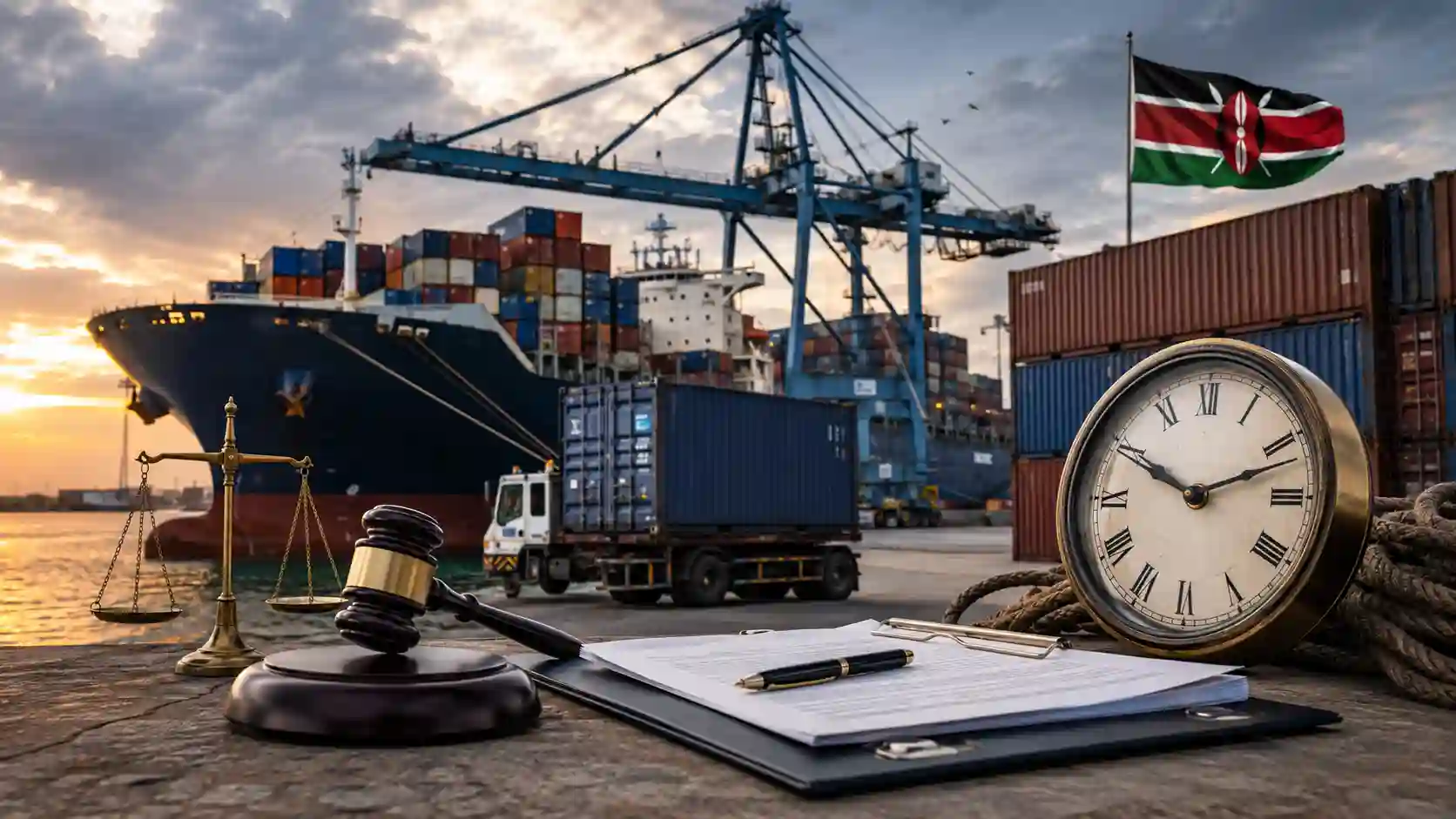
An Overview of the Legal Framework in Kenya’s Maritime Sector
Kenya’s growing importance as a regional maritime, logistics, and export hub has significantly increased the volume and complexity of maritime cargo disputes arising from international shipping and cross-border trade operations. As trade through the Port of Mombasa and East African transport corridors continues to expand industry players such as, exporters, insurers, freight forwarders, logistics operators, marine underwriters, and cargo interests are increasingly confronted with disputes involving delayed deliveries, cargo deterioration, release of cargo, marine insurance recovery proceedings, supply chain disruptions and maritime fraud.
For instance, within the horticulture, seafood, pharmaceutical, fresh produce, and temperature-controlled export sectors, timing is commercially critical. Perishable cargo depends on efficient routing, uninterrupted cold-chain logistics, and timely transit. Delays arising from reefer interruptions, customs processes, vessel substitutions, congestion, or extended transshipment periods can rapidly result in substantial losses.
In many disputes, international carriers rely on limitation clauses in Bills of Lading and their standard terms and conditions to deny or limit cargo claims. These disputes often involve complex legal issues relating to the applicable international carriage rules, the incorporation of international conventions into Kenyan law, statutory limitation periods, foreign jurisdiction and arbitration clauses, and the relationship between international shipping laws and Kenyan legal principles.
The Evolving Nature of Maritime Cargo Claims
CM Advocates LLP advises clients throughout the dispute lifecycle, from risk assessment and claim preservation to recovery proceedings, enforcement actions, and cross-border dispute resolution involving carriers, freight forwarders, logistics providers, insurers, and other maritime stakeholders.
This Regulatory Alert will seek to provide an overview of the legal framework governing maritime cargo delay and recovery claims in Kenya, together with key considerations for industry players in international trade and Kenya’s growing Blue Economy.
Maritime cargo disputes often require the coordination of legal, technical, and commercial evidence across multiple jurisdictions. Successful recovery efforts depend on early evidence preservation, careful review of carriage documents, prompt engagement with surveyors and insurers, and a clear understanding of the applicable contractual and statutory regimes. Maritime cargo claims are governed by a combination of international conventions, domestic legislation, and contractual carriage documents such as Bills of Lading. The applicable legal framework can significantly affect a party’s rights, remedies, liability exposure, and the time within which a claim must be brought.
The principal international regimes relevant to cargo disputes are the Hague Rules, the Hague-Visby Rules, and the Hamburg Rules, each of which adopts a different approach to carrier liability and cargo-owner protection.
Briefly and not exhaustively;
The Hague Rules; The Hague Rules are one of the principal international frameworks governing the carriage of goods by sea. They impose obligations on carriers to exercise due diligence in making vessels seaworthy and properly handling cargo, while also providing carriers with a number of liability protections and defenses. Of particular importance is the one-year limitation period under Article III Rule 6, which requires cargo claims to be commenced within one year of delivery, or the date when delivery should have occurred. This limitation period is strictly applied and frequently serves as a complete defence to cargo recovery claims.
The Hague-Visby Rules; The Hague-Visby Rules are an updated version of the Hague Rules and remain widely used in international shipping. They modernized certain aspects of the original framework, including cargo liability limits and provisions relating to containerized cargo and modern shipping practices. Like the Hague Rules, the Hague-Visby Rules contain important protections and liability limitations for carriers. Notably, the one-year limitation period for bringing cargo claims remains unchanged. Given their widespread incorporation into Bills of Lading and other carriage documents, the Hague-Visby Rules frequently play a central role in determining liability and recovery rights in maritime cargo disputes.
In Kenya, these regimes operate alongside domestic maritime legislation and constitutional principles governing the application of international treaties.
Kenya's Maritime Legal Framework
In Kenya, maritime cargo disputes are governed by a combination of international conventions, domestic legislation, and contractual carriage documents. Under Article 2(6) of the Constitution, treaties and conventions ratified by Kenya form part of Kenyan law.
However, the outcome of maritime disputes is often influenced not only by statutory and treaty provisions, but also by the terms of the applicable Bill of Lading, jurisdiction and arbitration clauses, and established principles of international maritime law. As a result, determining the applicable legal framework is often a critical first step in assessing liability and recovery prospects.
In practice, maritime cargo disputes in Kenya frequently turn on a limited set of recurring legal issues, including:
-
whether the Bill of Lading terms were validly incorporated into the contract of carriage;
-
whether the claim is time-barred under applicable Hague or Hague-Visby limitation provisions;
-
whether Kenyan courts have jurisdiction in light of exclusive jurisdiction or arbitration clauses;
-
whether delay constitutes actionable “loss or damage” under the governing regime or arises as a separate contractual breach;
-
whether the claimant has title to sue under the Bill of Lading; and
-
whether limitation or exclusion clauses are enforceable in the circumstances of the case.
Practical Considerations for Cargo Recovery Claims
Kenyan courts have generally demonstrated a consistent willingness to uphold the contractual architecture governing international carriage of goods, particularly where Bills of Lading have been properly incorporated and clearly govern the relationship between the parties. In practice, the outcome of maritime cargo disputes in Kenya is often determined by the terms of the applicable Bill of Lading, including liability regimes, jurisdiction clauses, arbitration agreements, and contractual limitation provisions. Kenyan courts have generally demonstrated a willingness to uphold such provisions where they have been properly incorporated into the contract of carriage.
Time limits are particularly important. Depending on the applicable legal framework and the nature of the claim, different limitation periods may apply, and failure to act within the prescribed period may result in an otherwise valid claim being time-barred.
Early preservation of evidence is equally critical, particularly in disputes involving delayed delivery, perishable cargo, reefer shipments, and other temperature-sensitive goods. Cargo interests should retain all relevant documentation, including Bills of Lading, booking confirmations, survey reports, reefer and temperature records, transshipment records, and correspondence relating to the shipment and alleged loss.
Given the complexity of maritime cargo claims and the potentially significant financial consequences arising from delay, deterioration, misdelivery, or other supply-chain disruptions, early legal assessment is often essential to preserve recovery rights and develop
Kenyan courts have considered the enforceability of Bills of Lading, limitation provisions, and jurisdiction clauses in several maritime disputes. In Pyrotechnics Company Limited v Maersk Kenya Limited [2021] KEHC 8546 (KLR), the High Court provided guidance on the treatment of contractual carriage terms and jurisdictional objections in cargo recovery disputes.
This decision reflects a broader judicial trend of upholding contractual certainty in international shipping arrangements, particularly where parties have expressly agreed to governing terms and forums.
Conclusion
Kenya’s maritime legal framework continues to develop in step with the expansion of the Blue Economy, evolving international trade corridors, and the increasing complexity of cross-border cargo recovery and logistics disputes.
Kenyan courts have generally demonstrated a consistent willingness to uphold the contractual architecture governing international carriage of goods, including Bills of Lading, Hague and Hague-Visby limitation regimes, exclusive jurisdiction clauses, and arbitration agreements. This judicial approach reflects a strong commitment to commercial certainty and predictability in international shipping transactions.
However, cargo litigation in Kenya is becoming increasingly nuanced. Emerging disputes frequently extend beyond traditional time-bar defences and jurisdictional objections to include issues such as delay-based cargo claims, reefer cargo deterioration, marine insurance subrogation, diversion of cargo, maritime fraud, and the interplay between contractual limitation regimes and broader principles of domestic civil liability.
In this evolving environment, cargo stakeholders should not assume that all claims are automatically defeated by contractual limitation provisions alone. Depending on the facts, claims may still arise where delay is the operative cause of loss, where cargo damage manifests progressively, where contractual representations are breached, or where equitable, statutory, or insurance subrogation principles are engaged.
Accordingly, early legal assessment, prompt evidentiary preservation, and timely procedural action remain critical to safeguarding recovery rights and mitigating exposure.
How CM Advocates LLP Can Assist
CM Advocates LLP advises a broad spectrum of maritime and trade stakeholders, including cargo interests, insurers, underwriting agents, exporters, freight forwarders, logistics operators, shipping lines, maritime financiers, and recovery professionals.
Our practice covers maritime cargo claims, delay and reefer disputes, admiralty litigation, vessel arrest and enforcement proceedings, cross-border recovery actions, trade documentation disputes, limitation and jurisdiction analysis, marine insurance disputes, cargo fraud investigations, asset tracing and recovery, and international commercial litigation.
Our multidisciplinary team integrates expertise across Blue Economy and Admiralty Law, International Trade, Civil Fraud and Asset Recovery (CFAR), Dispute Resolution and Appellate Practice, and complex cross-border commercial litigation.
This publication is provided for general information purposes only and does not constitute legal advice. Specific legal advice should be obtained for individual matters. should not be construed as a legal opinion or advise. If you need any further clarifications, please do not hesitate to contact Cyrus Maina, Managing Partner (cmaina@dvocates.com) Kelvin Mwaniki, Senior Associate (kmwaniki@cmadvocates.com), or your usual contact at our firm, for legal advice.
Main Contact
Cyrus Maina, Managing Partner (cmaina@dvocates.com)
Blue Economy and Maritime Law Unit
CM Advocates LLP
E: blueeconomy@cmadvocates.com
CM Advocates LLP – Contact Details
Head Office – Nairobi
I&M Bank House, 7th Floor
2nd Ngong Avenue
Nairobi, Kenya
P: P.O. Box 22588 – 00505, Nairobi Kenya
E: law@cmadvocates.com
Mombasa Office
Links Plaza, 4th Floor
Links Road, Nyali
Mombasa, Kenya
P: P.O. Box 90056 – 80100, Mombasa Kenya
E: mombasaoffice@cmadvocates.com
Regional Offices:
Uganda | Tanzania | Rwanda | Zambia | Ethiopia | South Sudan