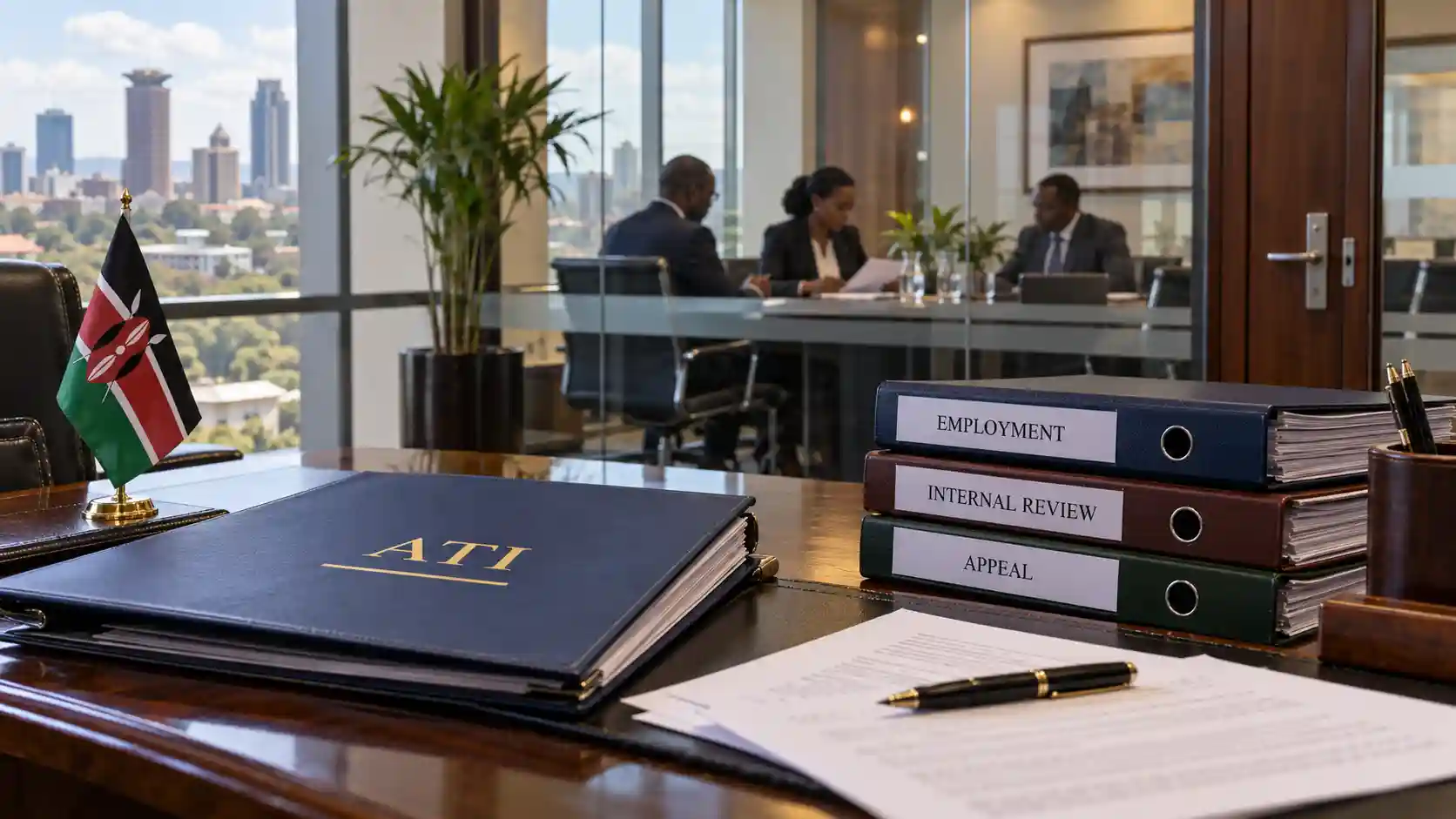
REGULATORY ALERT
Kenya Court of Appeal Upholds African Trade Insurance Agency (ATI) Immunity in Employment Disputes and the Requirement to Exhaust Internal Remedies
African Trade Insurance Agency (ATI) v Otieno & another (Civil Appeal 57 of 2020) [2026] KECA 1914 (KLR)
Date of judgment: 25th September 2026
Executive Summary
The Court of Appeal has upheld the African Trade Insurance Agency’s immunity from legal proceedings concerning personnel matters. In its judgment delivered on 25th September 2026, the Court held that an employment dispute could not overcome that immunity merely because it was presented as a constitutional petition.
The Court also held that the employee was required to exhaust the available internal dispute resolution procedures prescribed by his employment contract, the ATI Treaty and the Staff Manual. He had not demonstrated that those procedures were unavailable or ineffective.
The decision highlights the need for international organisations and their employees to establish the legal basis and scope of immunity, examine the substance of the dispute and identify the proper forum before commencing proceedings. Exhausting internal remedies does not, by itself, waive immunity or confer jurisdiction on the Employment and Labour Relations Court (ELRC).
The judgment is relevant to governing boards, legal departments, human resources teams and employees of international organisations operating in Kenya. Its application depends on the instruments governing the particular organisation and the nature of the claim.
Background
George Oduori Otieno filed a constitutional petition against ATI and the Attorney General, alleging violations arising from the termination of his employment.
His prayers included protection of his employment contract, declarations that the instruments conferring immunity on ATI were unconstitutional, constitutional damages, compensation for unfair loss of employment and compensation for the unexpired contractual term.
ATI raised a preliminary objection challenging the ELRC’s jurisdiction. It relied on the Privileges and Immunities Act, Legal Notice No. 89 of 2001, its establishing treaty and its Host Country Agreement.
ATI maintained that its immunity had not been waived and that the employee’s contract required disputes to be resolved exclusively under the procedures prescribed by the ATI Treaty and Staff Manual.
The ELRC dismissed the preliminary objection on 25th October 2019. ATI appealed, with the Attorney General supporting the appeal.
The Court’s Determination
The Court of Appeal allowed the appeal on 25th September 2026, set aside the ELRC’s ruling and substituted an order allowing ATI’s preliminary objection. Each party was directed to bear its own costs.
The decision concerned jurisdiction and the applicable dispute resolution framework. The Court did not determine whether the termination was lawful or award the compensation sought.
The Legal Basis and Scope of Personnel Immunity
Article 16(1)(b) of ATI’s establishing agreement expressly excludes actions against the Agency in respect of personnel matters.
Reading the applicable constitutional, statutory and treaty framework together, the Court held that ATI’s immunity extended to the employment dispute before it. No express waiver had been established.
The decision requires an organisation-specific assessment. The relevant establishing treaty, Kenyan implementing legislation or order, host agreement and any applicable waiver or exception must be examined before determining whether immunity protects an organisation against a particular claim.
An organisation’s international status, foreign funding or registration as an NGO or public benefit organisation should not, without examination of the applicable legal instruments, be assumed to confer immunity.
Constitutional Pleading Does Not Displace Established Immunity
The Court examined the substance of the petition and the reliefs sought.
Although the employee challenged the constitutionality of ATI’s immunity instruments, his claims arose directly from the employment relationship. The constitutional declarations were ancillary to that dispute.
The Court therefore held that the ELRC had erred in postponing determination of the immunity question until the substantive hearing.
For litigants, the practical implication is that jurisdiction must be assessed before selecting the form of proceedings. Allegations concerning equality, dignity, fair labour practices or access to justice do not, by themselves, displace an established immunity covering the dispute.
The judgment does not establish that every constitutional challenge involving an international organisation is barred. Its holding must be understood in the context of ATI’s express personnel immunity and the employment-based reliefs sought.
Immunity May Be Determined as a Preliminary Question
ATI’s status as an international organisation, the relevant legal notice, the absence of an express waiver and the employment origin of the dispute were not contested.
The objection therefore raised a pure question of law suitable for preliminary determination under the principles in Mukisa Biscuit Manufacturing Co. Ltd v West End Distributors Ltd [1969) E.A. 696.
Where material facts concerning an organisation’s status, the scope of protection, a purported waiver or the nature of the disputed conduct require proof, the appropriate procedure must be assessed separately.
The decision supports early determination of immunity where the necessary factual foundation is undisputed.
Internal Dispute Resolution and Exhaustion of Remedies
Clause 16 of the employee’s contract required disputes to be resolved exclusively in accordance with the ATI establishing agreement and Staff Manual.
The Court found that the employee had not demonstrated that the prescribed procedures were unavailable or ineffective. He was therefore required to exhaust the available internal remedies.
Immunity and exhaustion require separate analysis. Completing an internal procedure does not itself waive immunity or establish the ELRC’s jurisdiction. Any subsequent proceedings require an independent assessment of the applicable immunity, any valid waiver or exception, and the forum authorised by the governing instruments. The staff dispute resolution route must be established from the applicable employment contract, Staff Manual and relevant instruments.
Access to Justice and Constitutional Justification
The Court relied on the Supreme Court’s decision in Karen Njeri Kandie v Alassane Ba & another [2017] KESC 13 (KLR).
It recognised that immunity may serve the legitimate purpose of enabling international organisations to perform their functions and allowing Kenya to honour its international obligations. The Court also held that the right of access to justice under Article 48 may be lawfully limited in appropriate circumstances.
The constitutional justification remains material. Treaty obligations do not displace the supremacy of the Constitution, and the judgment does not establish that every assertion of immunity necessarily satisfies the applicable constitutional test.
Practical Implications
International Organisations and Governing Boards
International organisations should confirm the source and scope of their immunity by reviewing their establishing instruments, Kenyan implementing legislation or orders, host agreements and applicable exceptions.
Boards of such organisations should also establish who may authorise a waiver, the circumstances in which it may be granted and how it must be documented. Jurisdiction and dispute resolution clauses should be reviewed before contracts are executed.
Where proceedings are served, the organisation should obtain prompt advice on whether immunity applies and how the jurisdictional question should be presented.
Legal and Human Resources Departments
Employment contracts and Staff Manuals should accurately identify the applicable grievance and dispute resolution procedures. Employees should be able to understand how to initiate a complaint, the relevant decision makers, available appeal stages and applicable deadlines.
Organisations should assess whether those remedies operate effectively in practice. Access to the rules, a meaningful opportunity to present a case and reasoned decisions can reduce uncertainty and disputes concerning the adequacy of the process.
Records of appointments, renewals, performance management, disciplinary proceedings, termination decisions and internal appeals should be preserved. Immunity does not determine the merits of an employment dispute or remove obligations arising under the applicable employment framework.
Employees and Their Advisers
Employees should obtain their employment contracts, applicable Staff Manuals and the instruments establishing the employer’s claimed immunity before commencing proceedings.
They should identify the correct respondent, available remedies and competent forum, preserve relevant evidence and comply with applicable deadlines.
Where an internal procedure is inaccessible, ineffective or has not been implemented, the specific obstacle should be documented. An allegation that a dispute involves constitutional rights will not, on its own, overcome the jurisdictional protection recognised in this judgment.
Pensions and Employee Benefits
Claims concerning pensions, gratuity or other benefits require identification of the entity responsible for the obligation.
A claim against an international organisation as employer may require a different analysis from a claim against a pension scheme, independent trustees or another service provider. The ATI judgment did not determine those distinctions and should not be treated as granting blanket immunity in all pension or employee benefit disputes.
How we can Assist
Through our Employment, Pensions & Rewards Practice Group, working with our dispute resolution and public law teams where appropriate, CM Advocates LLP can assist with:
-
Assessing immunity, jurisdiction, waiver and the appropriate dispute resolution forum.
-
Reviewing employment contracts, Staff Manuals and internal grievance procedures.
-
Advising on workplace investigations, disciplinary processes, termination and separation arrangements.
-
Representing organisations and employees in internal proceedings and other legally available dispute forums.
-
Reviewing pension, gratuity and employee benefit obligations, including the identification of the responsible entity.
Conclusion
The judgment delivered on 25th September 2026 confirms that ATI’s express personnel immunity applied to the employment dispute before the Court and that constitutional pleading did not overcome that protection.
It also reinforces the requirement to use prescribed internal remedies where they have not been shown to be unavailable or ineffective.
For organisations and employees, the immediate priority is to confirm the applicable immunity instruments, clarify the dispute procedure and preserve the records needed to establish both the proper forum and the underlying employment claim.
Contact Us
For advice concerning employment disputes involving international organisations, privileges and immunities, employment contracts, Staff Manuals, internal grievance procedures, pensions and employee benefits, or related litigation, please contact:
Employment, Pensions & Rewards Practice Group
E: eprpractice@cmadvocates.com
Dispute Resolution & Appellate Practice Group
E: disputeresolution@cmadvocates.com
CM Advocates LLP – Contact Details
Head Office – Nairobi
I&M Bank House, 7th Floor
2nd Ngong Avenue
Nairobi, Kenya
E: law@cmadvocates.com
Mombasa Office
Links Plaza, 3rd Floor
Links Road, Nyali
Mombasa, Kenya
E: mombasaoffice@cmadvocates.com
Regional Presence
Uganda | Tanzania | Rwanda | Zambia | Ethiopia | South Sudan
Disclaimer
This regulatory alert is provided for general information only and does not constitute legal advice. The judgment may be subject to appeal, review or subsequent judicial consideration. Specific legal advice should be obtained regarding the facts and documentation of each matter.