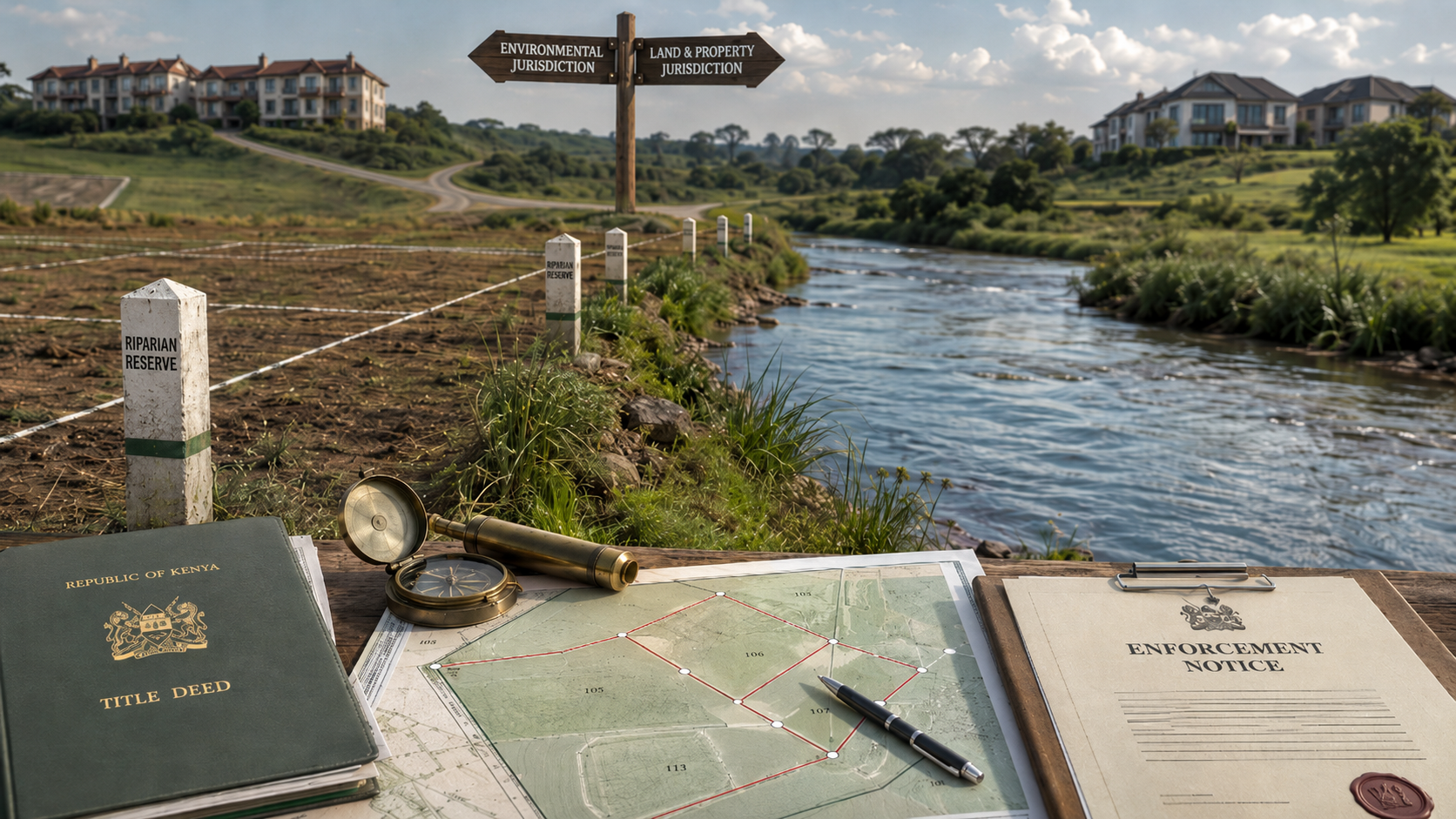
The increasing issuance of enforcement notices by the Water Resources Authority (WRA) requiring the removal or demolition of structures alleged to be situated within riparian reserves continues to generate significant legal uncertainty for landowners, developers, investors, lenders, infrastructure sponsors, and public entities.
These enforcement actions frequently raise complex questions concerning the proper forum for dispute resolution, the scope of the Water Tribunal's jurisdiction, the role of the Environment and Land Court (ELC), the protection of vested property rights, legitimate expectation, constitutional safeguards under Article 40 of the Constitution, and the retrospective application of regulatory standards.
Recent judicial developments, particularly the Court of Appeal decision in Superior Homes (Kenya) PLC v Water Resources Authority & 9 Others [2024] KECA 1102 (KLR) and the landmark jurisdictional decision in Co-operative Bank of Kenya Limited v Patrick Kang’ethe Njuguna & 5 Others [2017] KECA 79 (KLR), provide important guidance on how courts determine the appropriate forum for disputes involving land, environmental regulation, administrative action, and property rights.
The decisions confirm that jurisdiction is not determined simply by the fact that a dispute involves land or environmental regulation. Rather, courts must identify the dominant issue in dispute and determine jurisdiction accordingly.
Where a dispute primarily concerns technical water resource regulation, the Water Tribunal will ordinarily be the appropriate forum. However, where the dominant issue concerns ownership, title, constitutional property rights, compensation, legitimate expectation, or deprivation of vested proprietary interests, the Environment and Land Court may properly exercise jurisdiction.
The implications are significant for developers, landowners, investors, lenders, infrastructure project sponsors, and public entities whose projects or landholdings may be affected by riparian reserve enforcement measures.
Why this issue matters
The enforcement of riparian reserve requirements by the Water Resources Authority has become one of the most significant regulatory risks affecting Kenya's real estate, infrastructure, construction, hospitality, manufacturing, energy, and investment sectors.
In recent years, regulatory authorities have intensified enforcement activities relating to riparian reserves, wetlands, flood plains, water catchment areas, and environmentally sensitive zones. These actions have increasingly affected developments that were approved, financed, constructed, or acquired years before the current regulatory framework was implemented.
As a result, developers, investors, lenders, project sponsors, and landowners are increasingly confronted with notices requiring demolition, cessation of development activities, environmental restoration, or restrictions on the use of land.
These disputes frequently extend beyond technical environmental regulation and raise broader questions concerning constitutional protection of property rights, compensation, legitimate expectation, retrospective application of regulatory standards, and the extent to which public authorities may interfere with vested proprietary interests.
Against this backdrop, determining the correct forum for dispute resolution has become a critical strategic consideration.
Background
The Water Act, 2016 (the “Act”) establishes a specialized regulatory framework for the management, conservation, and protection of Kenya's water resources.
The Act establishes the Water Resources Authority as the principal regulator responsible for water resource management and enforcement and creates the Water Tribunal as a specialized forum for resolving disputes arising under the Act.
At the same time, the Constitution of Kenya establishes the Environment and Land Court as a superior court with jurisdiction over disputes relating to the environment, the use and occupation of land, and title to land.
The interaction between these statutory and constitutional frameworks has generated recurring jurisdictional disputes, particularly where WRA enforcement actions affect registered land rights, approved developments, and constitutional property interests.
The dominant issue test and jurisdictional disputes in Kenya
The leading authority on jurisdictional characterization remains Co-operative Bank of Kenya Limited v Patrick Kangethe Njuguna & 5 Others [2017] KECA 79 (KLR).
In that case, the Court of Appeal emphasized that jurisdiction is determined not by the mere involvement of land in a dispute but by the true nature, substance, or dominant issue of the claim. Although the dispute concerned charged land, the Court found that the dominant issue was the lender-borrower relationship and debt recovery. The matter therefore fell within the jurisdiction of the High Court rather than the Environment and Land Court.
The Court's reasoning established an important principle that continues to guide Kenyan courts: where multiple legal issues arise, courts must identify the dominant issue and determine jurisdiction based on the substance of the dispute rather than its form.
This dominant issue test has become one of the most influential jurisdictional principles in Kenyan jurisprudence.
The Superior Homes decision and its significance
The Court of Appeal's decision in Superior Homes (Kenya) PLC v Water Resources Authority & 9 Others [2024] KECA 1102 (KLR) provides significant recent guidance on riparian reserve enforcement disputes
The dispute arose after WRA issued enforcement notices alleging that residential developments adjacent to the Stoney Athi River had encroached upon riparian land.
The developer challenged the notices before the Environmental Land Court through consolidated judicial review and constitutional proceedings.
The Environment and Land Court found that the developments had received the requisite approvals, that WRA had previously confirmed compliance, that the properties were not situated on riparian land as defined under the applicable regulations, and that the enforcement notices were unlawful.
The Court of Appeal upheld those findings.
Significantly, the Court acknowledged the existence of the specialized statutory dispute resolution framework under the Water Act while also recognizing the constitutional role of the Environment and Land Court where constitutional rights and proprietary interests are implicated.
The decision continues to influence disputes involving riparian reserves, environmental regulation, administrative action, and constitutional property rights.
The Court's approach: substance over form
A recurring theme emerging from recent jurisprudence is the courts' preference for substance over form.
The critical question is not whether a regulator has issued the impugned decision or whether environmental issues are involved.
Rather, courts increasingly focus on the true character of the dispute.
Where the dispute concerns the technical correctness of hydrological assessments, riparian measurements, water permits, or regulatory directives, the matter will ordinarily fall within the specialized framework established under the Water Act.
Conversely, where the dispute principally concerns deprivation of property rights, ownership, title, compensation, constitutional protections, or the legality of interference with vested interests, the matter may properly fall within the jurisdiction of the Environment and Land Court.
This approach reinforces the importance of carefully characterizing disputes at the outset of any challenge to a WRA enforcement notice.
Water Tribunal jurisdiction under the Water Act, 2016
The Water Act establishes the Water Tribunal as the primary dispute resolution mechanism for appeals arising from decisions, directives, permits, enforcement actions, and regulatory determinations made by the Water Resources Authority.
Consistent with the doctrine of exhaustion, parties are ordinarily expected to utilize this statutory mechanism before resorting to the courts unless a recognized exception applies.
Recognized exceptions may arise where the statutory remedy is unavailable, ineffective, inadequate, where the challenge raises substantial constitutional questions that the Water Tribunal cannot effectively determine, or where urgent interim relief is necessary to prevent irreversible consequences.
The Tribunal remains the appropriate forum where disputes concern:
- Riparian reserve measurements;
- Hydrological assessments;
- Water abstraction rights;
- Permit conditions;
- Water resource management directives;
- Environmental restoration requirements;
- Regulatory compliance notices; and Technical enforcement decisions under the Water Act.
In such cases, the dispute is fundamentally regulatory and technical in nature and should ordinarily commence before the Water Tribunal.
Riparian reserve enforcement versus property rights
A more difficult question arises where WRA enforcement action affects registered titles, approved developments, financed projects, third-party purchasers, lenders, or vested proprietary interests.
The dominant issue may shift from water resource management to constitutional property rights where:
- The title predates the Water Act, 2016;
- Development approvals were lawfully issued before current regulatory standards;
- Existing investments are affected;
- Compensation issues arise;
- Legitimate expectations have been created by previous governmental approvals;
- The dispute concerns ownership or title; or
- Constitutional rights under Articles 40, 47 and 50 are implicated.
In such circumstances, the dispute may transcend technical regulatory questions and become fundamentally a land, constitutional, and administrative law dispute.
When does the Environment and Land Court have jurisdiction over riparian reserve disputes?
The existence of the Water Tribunal does not automatically mean that every riparian reserve dispute must ultimately be filed determined by the Water Tribunal. It does, however, mean that the Tribunal route must be considered carefully at the outset.
Applying the dominant issue test, and the exhaustion doctrine, the Environment and Land Court may properly exercise jurisdiction where the dispute principally concerns:
- Ownership of land;
- Registered title;
- Constitutional property rights;
- Compulsory acquisition;
- Compensation claims;
- Legitimate expectation;
- Administrative fairness;
- Judicial review of regulatory action;
- Land use and planning rights; or
- Constitutional interpretation concerning land and environmental rights.
Where such issues predominate, the dispute becomes fundamentally a land and constitutional rights dispute rather than a purely technical water resource dispute.
Implications for landowners, developers, investors and lenders
The decisions discussed above carry significant implications for stakeholders operating within Kenya's real estate, infrastructure, and investment sectors.
Landowners, developers, investors, lenders, project sponsors, and public entities should carefully evaluate the true nature of any dispute arising from WRA enforcement action before commencing proceedings.
The choice of forum may significantly affect available remedies, procedural requirements, timelines, litigation strategy, and ultimately the prospects of success.
Where ownership rights, constitutional protections, compensation rights, or vested proprietary interests are affected, parties should carefully consider whether the dominant issue extends beyond technical regulatory compliance.
Key considerations when responding to a WRA enforcement notice
Recipients of WRA enforcement notices should undertake a comprehensive legal assessment of:
- The date of title issuance;
- Historical survey records and deed plans;
- Existing development approvals;
- Environmental approvals and licences;
- Previous engagements with regulators;
- Applicable statutory and regulatory regimes;
- Potential constitutional implications;
- Compensation rights;
- Available Tribunal remedies; and Appropriate dispute resolution strategies.
Early intervention is often critical to preserving rights, protecting investments, and avoiding irreversible consequences.
Looking ahead
The intersection between environmental regulation, infrastructure development, land use planning, constitutional property rights, and climate governance is likely to generate increasing litigation over the coming years.
As regulatory enforcement activity continues to expand, courts will inevitably confront additional disputes concerning riparian reserves, wetlands, environmental compliance obligations, and the application of the dominant issue test in determining jurisdiction.
Future decisions are likely to continue shaping the balance between environmental protection objectives and constitutional safeguards protecting private property and legitimate commercial expectations.
For developers, investors, lenders, landowners, and public entities, early legal assessment and strategic forum selection will remain essential components of effective risk management.
Key takeaway
The decisive question is not whether land is involved, but rather what the dispute is fundamentally about.
If the dispute primarily concerns water resource regulation, riparian determination, technical assessments, permits, or compliance requirements, parties should ordinarily pursue remedies before the Water Tribunal.
However, where the dominant issue concerns ownership, title, constitutional property rights, compensation, legitimate expectation, or deprivation of vested proprietary interests, the Environment and Land Court may properly exercise jurisdiction.
Each matter must therefore be assessed on its own facts, with particular attention paid to the true substance of the dispute rather than the identity of the regulator involved.
How we can assist
Through its Real Estate, Infrastructure & Environmental Disputes Unit (RIEDU), a specialist unit within the Dispute Resolution & Appellate Practice Group, CM Advocates LLP provides integrated advisory, litigation, arbitration, regulatory defence, judicial review, constitutional litigation, enforcement, and appellate advocacy services for complex land, infrastructure, environmental, natural resources, planning, development, and property rights disputes.
RIEDU works closely with the Firm's Real Estate, Development & Built Environment (REDBE), Projects, Construction & Infrastructure (PCI), Government Advisory, Public Law & Regulatory Litigation (GAVEL), Constitutional, Administrative & Regulatory Unit (CARU), Investigations, Compliance & Regulatory Defence (ICRD), Strategic Appeals & Advocacy Unit (SAAU), and other specialist practice groups to deliver multidisciplinary solutions across the full dispute lifecycle.
This Regulatory Alert forms part of CM Advocates LLP's ongoing Legal Insights Series covering real estate, infrastructure, environmental regulation, constitutional law, regulatory enforcement, natural resources, and emerging jurisprudential developments affecting businesses, investors, developers, financial institutions, public entities, and property owners across Kenya and the wider East African region.
For further information
Real Estate, Infrastructure & Environmental Disputes Unit (RIEDU)
A Specialist Unit Within the Dispute Resolution & Appellate Practice Group
Practice Group Contact E: disputeresolution@cmadvocates.com
Dispute Resolution & Appellate Practice Group
CM Advocates LLP – Contact Details
Head Office Nairobi
I&M Bank House, 7th Floor, 2nd Ngong Avenue
T: +254 20 2210978 or +254 716 209673
P.O. Box 22588 – 00505, Nairobi Kenya
Mombasa Office
Links Plaza, 3rd Floor, Links Road, Nyali
T: +254 041 447 0758 / +254 41 447 0548
P.O. Box 90056 – 80100, Mombasa Kenya
E: mombasaoffice@cmadvocates.com
Regional Presence
Uganda | Tanzania | Rwanda | Zambia | Ethiopia | South Sudan
Disclaimer: This publication is provided for general information purposes only and does not constitute legal advice. Professional advice should be obtained in relation to specific facts and circumstances before taking or refraining from any action.