KEY TAKEAWAY
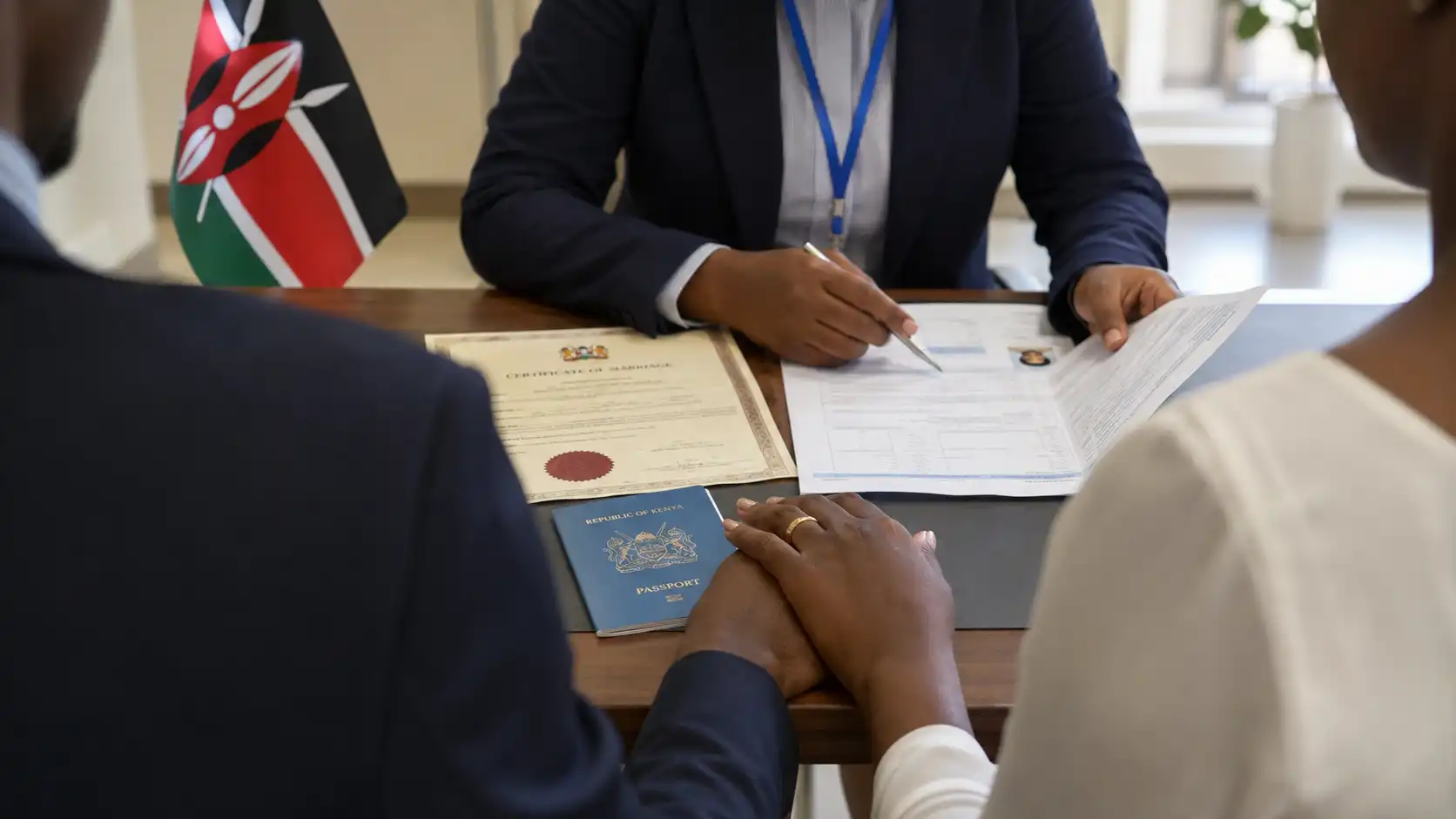
Marriage to a Kenyan citizen does not automatically make the foreign spouse a Kenyan citizen. After at least seven years of marriage, the spouse is constitutionally entitled to apply for registration, provided the marriage is legally recognised, genuine and subsisting, and the statutory eligibility requirements are met. Approval results in citizenship by registration, not citizenship by birth.
-
Legal basis and qualifying period
Article 15(1) of the Constitution of Kenya, 2010 provides that a person who has been married to a Kenyan citizen for at least seven (7) years is entitled, on application, to be registered as a Kenyan citizen. Section 11 of the Kenya Citizenship and Immigration Act, 2011 gives effect to that constitutional entitlement.
The seven (7) year period concerns the duration of the marriage. Section 11 does not state that the applicant must have lived continuously in Kenya throughout the entire period. However, the applicant must maintain lawful immigration status while present in Kenya. In practice, the Department of Immigration Services currently requires applicants to provide a copy of their valid dependant's pass or entry permit as part of the citizenship application record.
-
Statutory eligibility conditions
An applicant must satisfy all of the following conditions:
-
has been married to a Kenyan citizen for at least seven (7) years when the application is made.
-
The marriage was solemnized under a system of law recognised in Kenya, whether it took place in Kenya or abroad.
-
The marriage is genuine and was not entered into to obtain an immigration or citizenship status or privilege.
-
The marriage remains subsisting at the date of application.
-
The applicant has not been declared a prohibited immigrant under the Act or any other law.
-
The applicant has not been convicted of an offence and sentenced to imprisonment for three (3) years or longer.
Foreign marriage certificates may need to be authenticated, legalized or apostilled, depending on the requirements applicable in the issuing country. Where the certificate is not in English, a certified English translation should also be provided as part of the application.
-
Dual citizenship: can the applicant retain the original nationality?
Kenyan law recognizes dual citizenship, but the precise outcome for a spouse registered as a Kenyan citizen must be considered together with the law of the applicant's existing country. Some countries permit retention of the original nationality while others require prior consent, notification or automatic loss upon voluntary acquisition of another citizenship.
The applicant should therefore obtain advice in the other country before completing the Kenyan process. The Kenyan application should disclose every nationality held and should not assume that the constitutional protection in Article 16, which expressly protects Kenyan citizens by birth who acquire another nationality, automatically resolves the foreign country's rules.
Once registered, the person holds Kenyan citizenship by registration. That status carries citizenship rights but remains subject to the constitutional revocation grounds applicable to citizenship by registration, including fraud, false representation or concealment of a material fact.
-
Current documentary requirements
The Directorate of Immigration's current eFNS information pack and citizenship checklist identify the following principal requirements:
|
Document |
Purpose / key point |
|
|
Form 8 |
Printed online application, duly completed and attested by a Commissioner for Oaths. |
|
|
Questionnaire |
The prescribed citizenship-by-marriage questionnaire, completed accurately and consistently with the application. |
|
|
Photographs |
Two recent passport-size photographs. |
|
|
Marriage evidence |
Copy of the marriage certificate and supporting evidence where registration, authentication or translation is required. |
|
|
Character evidence |
Original certificate of good conduct / police clearance certificate, with any additional foreign clearances requested during vetting. |
|
|
Identity documents |
Copy of the applicant's valid passport and the Kenyan spouse's passport and national identity card. |
|
|
Joint affidavit |
A sworn affidavit by both spouses confirming the marriage, its duration, genuineness and continuing subsistence. |
|
|
Immigration status |
Copy of the applicant's dependant pass or relevant entry permit. |
|
-
Official fees
The current department of Immigration citizenship checklist states an application/processing fee of Kes.20,000. It further lists an issuance fee of KES 50,000 for East African applicants and KES 100,000 for non-East African applicants. The registration fee is stated to be non-refundable. Fees, payment channels and classifications should be confirmed against the invoice generated on eFNS at the time of filing.
The statute does not prescribe a guaranteed determination period. Actual timing depends on completeness, document verification, security vetting, interviews and administrative workload. Applicants should not make irreversible travel, employment or nationality decisions on the assumption of approval by a particular date.
-
Common risk areas and grounds for delay or refusal
-
Inconsistent records: Differences in names, dates, marital status, passport details or residential histories across documents.
-
Marriage validity: A foreign, customary, Islamic, Hindu or other marriage not adequately evidenced or registered under the applicable legal framework.
-
Insufficient proof of subsistence: Separation, pending divorce, contradictory addresses or limited evidence of a continuing marital relationship.
-
Adverse immigration history: Overstays, permit gaps, removal issues, prohibited immigrant status or undisclosed applications.
-
Criminal and security concerns: A disqualifying conviction, incomplete police clearance history or unresolved vetting issue.
-
Material non-disclosure: Failure to disclose other citizenships, prior marriages, criminal matters, immigration breaches or relevant family circumstances.
-
Death, separation and dissolution of marriage
The marriage must be subsisting when the application is made. A divorced former spouse cannot rely on section 11 merely because the marriage previously lasted seven years. A widow or widower of a Kenyan citizen may have a separate route under section 12 and Form 9, subject to the applicable conditions and evidence.
Once Kenyan citizenship has been validly acquired, Article 13(3) provides that citizenship is not lost merely through marriage or dissolution of marriage. Citizenship obtained by fraud, false representation or concealment remains vulnerable to revocation under Article 17 and the Act.
-
Practical pre-filing checklist
-
Confirm the precise marriage date and that seven full years have elapsed before submission.
-
Verify that the marriage certificate is legally recognised in Kenya and complete any authentication or translation formalities.
-
Reconcile names and biographical details across passports, permits, IDs, certificates and affidavits.
-
Prepare a coherent evidence file demonstrating a genuine and subsisting marriage.
-
Review the applicant's full immigration, criminal and citizenship history before swearing the joint affidavit.
-
Obtain advice on whether the applicant's existing nationality will be retained, lost or require notification.
-
Keep lawful immigration status in force until citizenship is formally granted and the relevant Kenyan documents are issued.
-
Conclusion
Citizenship by marriage is a constitutional entitlement to apply, but it is not an automatic or purely documentary conversion of marital status into citizenship. The application must establish legal eligibility, the authenticity and continuity of the marriage, good character and full candour on immigration and nationality history.
A carefully prepared application should treat the Form 8, questionnaire, joint affidavit and supporting documents as a single evidentiary record. Any inconsistency may trigger further scrutiny, delay the decision or expose a later grant to revocation risk.
HOW CM ADVOCATES CAN ASSIST
Eligibility assessment | Form 8 and questionnaire review | Joint affidavits | Foreign-document authentication | Immigration-status regularization | Dual-nationality advice | Interviews, follow-up and administrative-law remedies
Contacts:
Immigration and Global Mobility Practice | E: immigration@cmadvocates.com
International Family Advisory Unit | E: internationalfamily@cmadvocates.com
CM Advocates LLP – Contact Details
|
Head Office – Nairobi |
Mombasa Office |
|
I&M Bank House, 7th Floor |
Links Plaza, 3rd Floor |
Regional Presence
Uganda | Tanzania | Rwanda | Zambia | Ethiopia | South Sudan
Disclaimer
This publication is provided for general informational purposes only and does not constitute legal or tax advice. Specific professional advice should be sought in relation to particular facts, marriage validity, citizenship status, immigration applications, dual nationality, public-office eligibility, cross-border taxation, succession, family arrangements or regulatory compliance matters. Requirements, fees and procedures may change.
© 2026 CM Advocates LLP. All Rights Reserved.