If you work in sustainability, you've definitely heard of the Conference of the Parties (COP). But here's a question:
If someone asked you how many COPs exist under the United Nations, what would your answer be?
For many people, the immediate response is the Climate Change COP under the United Nations Framework Convention on Climate Change (UNFCCC) which is preparing for COP31, to be hosted by Türkiye. Others may also mention the Convention on Biological Diversity (CBD) COP on biodiversity.But that's not the complete picture.
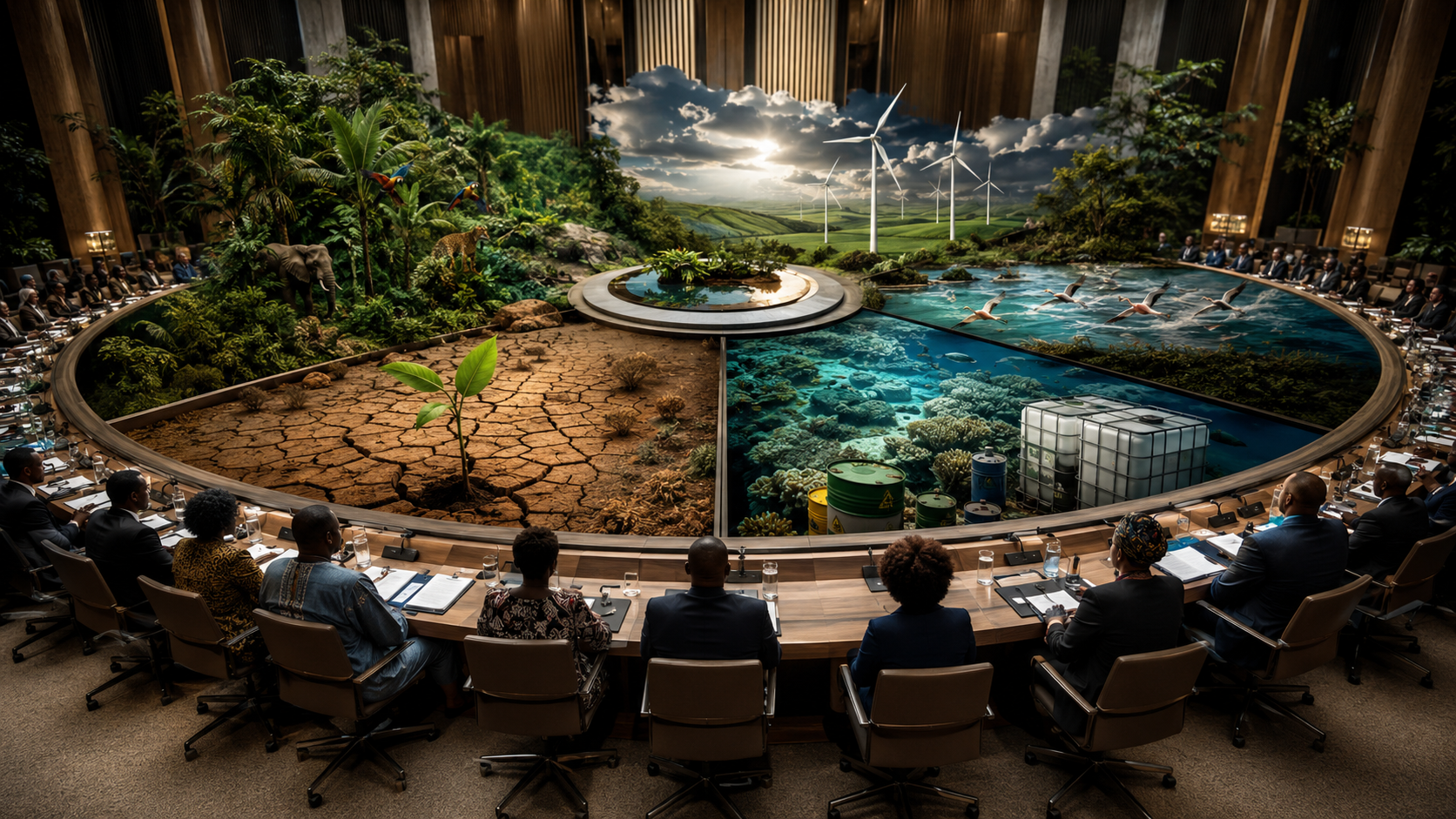
Did you know the United Nations has three major environmental COPs under what are known as the Rio Conventions?
The Three Rio Conventions: One Planet, Three Interconnected Challenges
(a) United Nations Framework Convention on Climate Change (UNFCCC) – Climate Change
The UNFCCC provides the global legal framework for reducing greenhouse gas emissions, strengthening climate resilience and supporting adaptation to climate change. It is the parent treaty of the Paris Agreement.
It addressed these SDG 13 (Climate Action, SDG 7 (Affordable and Clean Energy), SDG 11 Sustainable Cities and Communities) and SDG 12 (Responsible Consumption and Production).
(b) Convention on Biological Diversity (CBD) – Protecting Nature and Biodiversity.
The CBD aims to conserve biodiversity, promote the sustainable use of natural resources and ensure the fair sharing of benefits from genetic resources. It recognises that healthy ecosystems are essential for food security, clean water, livelihoods and human wellbeing.
It covers SDG 15 (Life on Land), SDG 14 (Life Below Water), SDG 2 (Zero Hunger) and SDG 6 (Clean Water and Sanitation).
(c) United Nations Convention to Combat Desertification (UNCCD) – Restoring Land and Building Drought Resilience.
The UNCCD focuses on preventing and reversing land degradation, restoring ecosystems and improving resilience to drought through sustainable land management. Its central objective is achieving Land Degradation Neutrality (LDN). It seeks to address SDG 15 (Life on Land), SDG 2 (Zero Hunger), SDG 1 (No Poverty), SDG 6 (Clean Water and Sanitation) and SDG 13 (Climate Action).
The three conventions address interconnected challenges. Climate change accelerates biodiversity loss and land degradation; healthy biodiversity strengthens climate resilience; and restored land stores carbon, supports ecosystems and improves livelihoods. Together, they provide a coordinated framework for achieving the Sustainable Development Goals and advancing sustainable development. Together, these conventions recognise a simple truth: climate change, biodiversity loss and land degradation are interconnected. Addressing one while ignoring the others is unlikely to deliver lasting sustainability.
Now, let's focus on UNCCD. Let’s Think Land.
As Kenyans, we understand the value of land perhaps better than most. Land is identity. It is livelihood. It is inheritance. It is wealth. It is where families are raised, food is grown, businesses are built, and unfortunately, where some of our deepest conflicts arise. People have gone to court and even lost their lives over land.
If you come from fertile, green parts of Kenya, you may never fully appreciate the value of productive land until you meet communities living in the Arid and Semi-Arid Lands (ASALs), or families whose once-fertile farms have slowly turned into barren landscapes.
Then ask yourself:How does productive land become degraded?
Remember what you learned in school:
· Deforestation.
· Unsustainable farming practices.
· Overgrazing.
· Poor land management.
· Soil erosion.
· Unsustainable charcoal production.
· Climate change and prolonged droughts.
· Rapid urbanization without environmental planning.
Now pause for a moment.
What part have our own actions, knowingly or unknowingly, played in degrading the land around us?Every tree cut without replacement...Every wetland encroached upon...Every hill stripped bare...Every piece of land left vulnerable to erosion...
All these decisions accumulate over time.
And when land degrades, the consequences are enormous: declining agricultural productivity, water scarcity, food insecurity, displacement of communities, conflicts over shrinking natural resources, loss of biodiversity, and deepening poverty.
This is precisely why the United Nations Convention to Combat Desertification (UNCCD) exists.Its mission is to prevent and reverse land degradation, restore ecosystems, build resilience to drought, and promote sustainable land management. In essence, it reminds us that healthy land is the foundation of healthy economies, healthy communities, and a healthy planet.
This is also closely linked to the Sustainable Development Goals, particularly SDG 15 – Life on Land, which calls for protecting, restoring, and sustainably using terrestrial ecosystems.
In about a fortnight, the global community will gather in Mongolia for UNCCD COP17. Governments, scientists, Indigenous peoples, civil society, youth, the private sector, and development partners will deliberate on practical solutions to restore degraded land, strengthen drought resilience, promote sustainable agriculture, mobilize finance for land restoration, and accelerate progress toward Land Degradation Neutrality (LDN).
These conversations matter.
Because every restored hectare means more food. More water. More biodiversity. More livelihoods. More peace.
Land is not just what we stand on.
It is what sustains us.
As the discussions unfold at UNCCD COP17, I encourage you to follow them closely. You may discover that your work, profession, business, community, or daily choices have a much bigger role in protecting our land than you ever imagined.
After all, sustainability is not only about reducing carbon emissions.
It is also about ensuring that the land we inherited remains productive, resilient, and capable of sustaining future generations